Population of Dubai: Its Growth and Development in The Next Five Years
Table of Contents
A 19th-century treaty between the Emirates and the British resulted in the collation of the Emirates known as the Trucial States. After their liberation from the British Treaty, the United Arab Emirates (UAE) was born. UAE’s small population of around 70,000 grew drastically upon the discovery of oil in the 1950s. This was a turning point in the country’s history, resulting in an economic boom, growth, and transformation. This turned what was once a small fishing village into a global trade hub.
The seven Emirates consist of Dubai, Ajman, Ras Al Khaimah, Sharjah, Umm Al Quwain, Fujairah, and its capital, Abu Dhabi. Though the UAE occupies only a small part of the Arabian Peninsula on the eastern end, it is a formidable power with numerous resources.
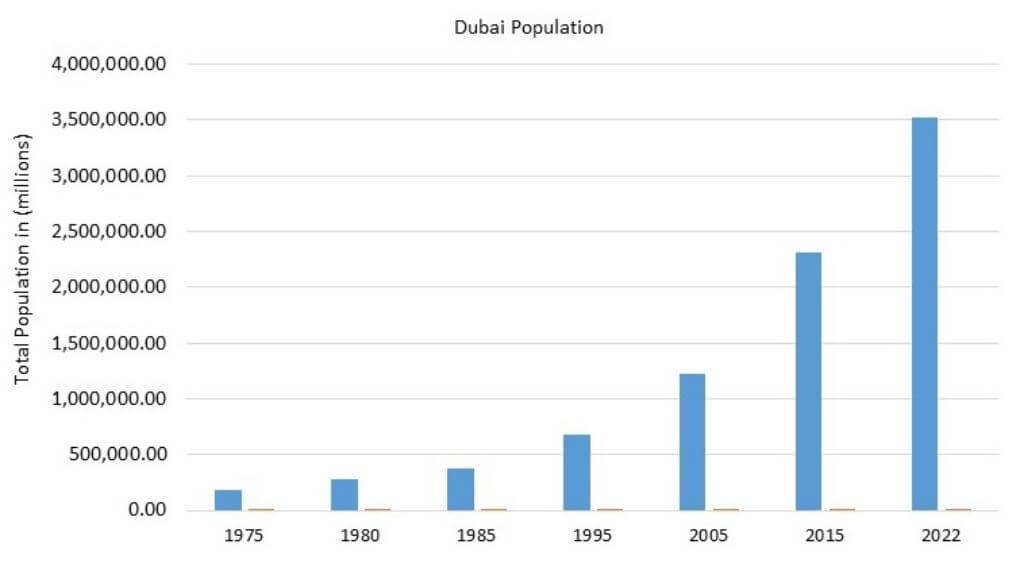
From 1.1 million in 1980 to over 12 million in 2024, the UAE has witnessed a steady population growth with the population of Dubai itself approximating at around 3.6 million as of the first quarter in 2024.
Key Reasons for Dubai Population Growth
Dubai is a magnet for foreign investors and expatriates alike, courtesy of its exceptional job market focused on tourism, finance, technology, and real estate. The presence of big corporations, coupled with a continuously expanding business sector, creates abundant employment opportunities.
Dubai’s strategic location makes it a global hub for international trade and travel, and it is supported by robust infrastructure and connectivity. This city’s appeal is further magnified due to the high quality of life offered. From a purely economic perspective, the tax concessions offered by the UAE government attract foreign business and investment worth millions.
This financial incentive makes Dubai the go-to destination for entrepreneurs and professionals alike. Dubai’s vibrant multicultural community, welcoming attitude, prized real estate market, proactive government policies, booming tourism and hospitality sectors, and exceptional trade policies make this city a driver of economic opportunities.
Dubai population trends
Dubai’s population statistics are as varied as its residents, and this section provides a bird’s eye view.
Current Demographics
Dubai’s demographics are characterized by steady growth and diversity, which results in an amalgamation of economic opportunities and diverse cultures. It’s truly a hot spot of ethnic, cultural, linguistic, and religious diversity.
The majority of the population belongs to the working age group of 25-54 years. Known for its religious tolerance, Dubai’s multicultural landscape houses various religions, such as Hindus, Buddhists, Sikhs, and Christians, with Islam being its official religion. Though Arabic is Dubai’s official language, English is adopted and widely spoken across the country.
An interesting aspect of Dubai’s demographics is its overall life expectancy of around 76 years, as per the World Health Organization’s 2015 data.
Source: https://www.researchgate.net/
Dubai population density
The global business hub, Dubai is the largest and most densely populated city in the UAE. It is now depicted with around 3.6 million population in 2024. Though it roughly covers only 35 sq. km. with around 4000 km accounting for the metropolis, its population density is approximately 762 individuals per sq. km.
Dubai’s population has undergone a dramatic change and has grown exponentially over the last decade owing to a steady influx of foreigners, especially in the form of the workforce. This is again related to Dubai’s robust economy, fuelled by rapid development and ever-increasing economic opportunities.
Percentage of expats in Dubai
Renowned for its innovation and opulence, the expat population of Dubai outshines the Emiratis by 85%. This global city is home to over 200 nationalities. Dubai’s expat population by nationality is predominantly South Asian, with Indians accounting for 51% of the expat community, while those originally from Pakistan, Bangladesh, and the Philippines amount to 17%, 9%, and 3%, respectively.
It is also home to expats from Iran, Egypt, Nepal, Sri Lanka, China, and other Western countries, including Britain and Somalia.
The fate is promising for Dubai as countless benefits and business opportunities attract investors and entrepreneurs across the globe. The increasing number of business setups in the UAE are showcasing the true benchmark of it.
Dubai urban population
Another fascinating aspect of the economy is that most of the population of Dubai is concentrated in the urban areas. It is collectively amounting to 87.9% according to the Dubai Statistics Centre. This is not surprising given the city’s thriving economy fuelled by government initiatives focused on tourism, real estate, trade, and finance.
The population of Dubai is expected to increase at its current rate over the next five years, approaching six million by 2040. The city, society, and economy will all benefit from this population increase. Increased consumer spending and a more expansive and varied talent pool are the primary results.
The retail, real estate, and service sectors profit from this, as will investment alternatives, foreign investment and tourists, and job prospects. The final result is the growth and development of the country’s economy.